
Ettienne-Murphy
  • Home
  • About
  • Children's Author
  • Trainee Psychologist
  • My Research
  • Dyslexic Diaries
  • Teaching & Learning
    • Downloads
    • Phonics >
      • Phonics Catch Up
    • Early Career Teachers
    • Vocabulary Builder
    • Maths Page >
      • Division
  • Shop
  • Diamond Education hub
  • Teaching Resources
  • Ettienne Hub
  • English EYFS -KS4
    • Teaching GCSE English
    • Reluctant Readers
    • Grammar
    • Letter Formation
  • Maths KS1-3
    • Maths Teaching Tips
    • Division
    • Fractions
  • Learning Videos
  • Child Development
    • PDA Autism
    • Dyslexia
    • Autism
  • Planners
  • Cindy Lorraine
    • In Layman's Terms
    • My Therapy room
    • Wellness & Beauty
    • Video Diary
  • The Staffroom
    • Behaviour Management
  • After School Club
  • Resource Samples
    • Templates
  • Assessment for Learning
  • Contact
  • Blog
    • Story Writing
    • What are the Benefits of Foreshadowing?
    • Advice for New Teachers
    • Leadership in 2024?
    • Quality Teaching Resources
    • Phonics 'ea' Digraph
  • Members Page
  • My Therapy Room
  • Podcasts
Picture
​Chunking is a method of division that refers to breaking down larger numbers into smaller, more manageable parts. This technique is mentioned in the Ancient Greek document called Euclid's Elements and has been used ever since by mathematicians and students, alike. It is a great way to grasp difficult division problems before further analysing them.

With chunking, the process of division begins by breaking down the dividend, or the larger number being divided, into smaller manageable chunks. For example, if you were dividing 256 by 8, you would start by chunking 256 into 8 equal parts of 32. The process would then involve dividing 8 into 32; 4 times. As each 8 is removed from 32, the result would be 4, 32 divided by 8 is 4.

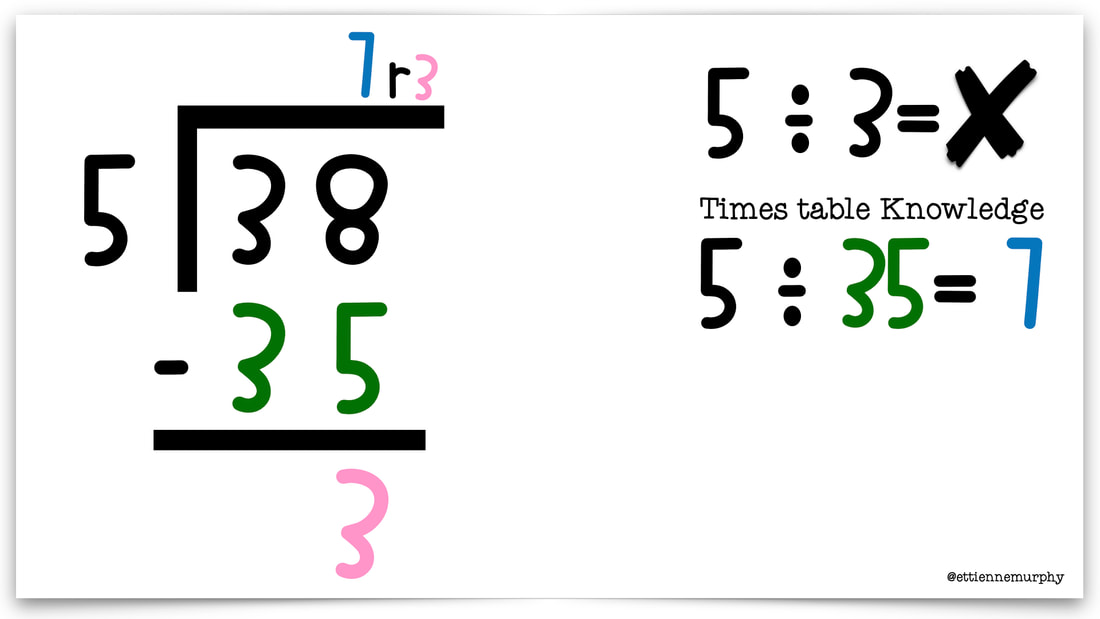
The Bus Stop Method


Chunking can also be used to solve complex division problems such as long division and decimal points. With long division, chunking can help simplify the steps by breaking the dividend down into smaller parts that can be easily divided. When using decimal points, it can help reduce the complexity by breaking the dividend down into fractions, which can then be divided more easily. 

Overall, chunking is a useful and reliable method of division that can help simplify more complex equations and make them easier to understand. It is a great tool for both experienced mathematicians and beginner students because it allows for larger numbers to be broken down in more manageable parts that can then be divided more accurately.
Picture

Ettienne-Murphy     


Hours

M-F: 8am-2pm

Email

[email protected]
  • Home
  • About
  • Children's Author
  • Trainee Psychologist
  • My Research
  • Dyslexic Diaries
  • Teaching & Learning
    • Downloads
    • Phonics >
      • Phonics Catch Up
    • Early Career Teachers
    • Vocabulary Builder
    • Maths Page >
      • Division
  • Shop
  • Diamond Education hub
  • Teaching Resources
  • Ettienne Hub
  • English EYFS -KS4
    • Teaching GCSE English
    • Reluctant Readers
    • Grammar
    • Letter Formation
  • Maths KS1-3
    • Maths Teaching Tips
    • Division
    • Fractions
  • Learning Videos
  • Child Development
    • PDA Autism
    • Dyslexia
    • Autism
  • Planners
  • Cindy Lorraine
    • In Layman's Terms
    • My Therapy room
    • Wellness & Beauty
    • Video Diary
  • The Staffroom
    • Behaviour Management
  • After School Club
  • Resource Samples
    • Templates
  • Assessment for Learning
  • Contact
  • Blog
    • Story Writing
    • What are the Benefits of Foreshadowing?
    • Advice for New Teachers
    • Leadership in 2024?
    • Quality Teaching Resources
    • Phonics 'ea' Digraph
  • Members Page
  • My Therapy Room
  • Podcasts